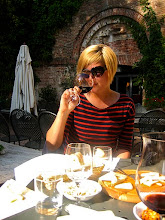
I'm in the process of writing a final blog post to describe my final month of traveling in Argentina: lo que vi, hice, comí, sentí (o sea, lo que me pasó.) Entonces...eso es lo que me pasó en Salta y Jujuy.


 This guy drew the short straw and was in the cage next to the peacocks.


 ¡Que rico! Chocolate-covered, dulce de leche filled churros...

 Boina? Check. Impressive moustache? Check.


 Yes, that's a sheep.


Every year prize-winning animals from across Argentina are brought to La Rural for an “Exposición de Ganadería, Agricultura, e Industria Internacional”, or a sort of state fair-esque event. Cows, horses, chickens, sheep, and the like are brought on display for porteños and their children to gawk at. Or so I thought.
I initially had no intention of going – the thought of thousands of loud kids running around barnyard animals had no appeal to me. But after several of my students had explained that it was typically Argentine event and represented a different part of Argentine society, I thought I would give it a go.
Ok, in reality I heard that in addition to the animals, there were vendors selling artisanal cheese, cured meats, dulce de leche and other sweets. Moreover I was told that free samples were involved, and lots of ‘em. I’m convinced that there are certain universal pleasures in this world, things that are guaranteed to bring a smile to your face, no matter your circumstances. And no, I’m not waxing profound…I’m simply alluding to things like bubbles, magnets, miniature horses, and free samples. Seriously, if you randomly saw a miniature horse walking on the sidewalk (as I did on my way to La Rural), would you not fail to smile? As for bubbles and magnets, maybe that’s a bit puerile, but come on – how cool are magnets?
But I digress. So it was the prospect of free samples more so than animal-gawking that drew me to La Rural, but I was extremely glad that I went. I had tried to go on Sunday, but upon seeing the 5-block-long line, I decided against it. (I later read in a newspaper that around 100,000 people attended La Rural on Sunday alone.) I tried again on Tuesday, and despite it being the last day, it was not too crowded.
And for me, it was magical.
Perhaps it’s the fact that I’ve been in the concrete jungle of Buenos Aires for too long, or perhaps it’s because I’m from the suburbs and have some glorified notion of farms, but it was refreshing (metaphorically, not literally; the entire place smelled of hay/shit) to see the animals. I’m not a big fan of zoos or spending an afternoon staring at caged animals, so initially I was a bit turned off by the whole set-up. But this repugnance was quickly taken over by sheer wonder. Yes, I’m just talking about cows, but these were cows. Not just any ol’ Bessie. While I had thought that I would brush quickly by the animals and head straight for the food, I found myself gawking and pointing in amazement along with all the porteño children I had intended to avoid.
Looking back, I’m not sure why I expected the animals would be such a bore. El campo – the farms and countryside – has always been the heart of Argentina, a country which is, to a great extent, an agricultural country. Argentine beef is renowned throughout the world, so it’s no surprise that the country’s most-prized animals are impressive. And fuckin’ huge!
I would have to say that the cows were my favourite, followed by the sheep – all different varieties – and chickens. Again, barnyard animals can seem so mundane, but these animals were truly beautiful (and it’s not just because of my untrained eye.) Here are some photos, though as always, I don’t think they do the animals justice (but I’ll blame that on the cages and not my mediocre photography skills.)
(Ok, scratch that, I'll do a separate post with pictures; my computer is acting up.)
Beyond the animals, the people were my favourite part of the fair. So I have this weird thing about taking candid pictures of old and interesting looking people…it’s a bit creepy, I know, but it’s what I do. And La Rural was full of just those kind of people. Many were older and wealthy - I assume they own a lot of land. With their fur coats and multiple diamonds, they reminded me, to a certain extent, of the country club crowd back in the States (not that I have frequented a country club.) Others, however, were the more traditional farmhands and workers. Here are some candid pictures – pardon the blurriness, I was trying to be stealthy (although I almost always failed and was noticed, but the men didn’t seem to mind that I was taking their picture.)
Again, I'll post them later...
As strange as it sounds, I was completely inspired by the fashion…at the agricultural fair. Seriously. If I were a dude, I’m pretty sure I would grow a thick mustache, don a boina (beret), some bombachas de campo (gaucho pants), thick leather boots, a poncho, and look like these guys:

I did buy myself a boina, and I’m determined to make it work. There are some people who wear hats and look impeccably chic, and others who look tragic in hats, no matter the style. I unfortunately fall into the latter group. But these boinas were adjustable, meaning it actually fits my big head, so I haven’t given up hope…yet. I will rock a boina, it’s just a matter of time.
The free food samples did not disappoint, either. I’m pretty sure my new favourite words en castellano are “Vení a probar!” (Come and try!) And come and try I did…several times. Outside were the cheese, cured meats, and pastry vendors. After making the rounds – several times over – I decided to actually sit and have a choripan. Oh, how I loves the choripan. It’s so simple – a chorizo (sausage), bland white bread (which I otherwise dislike and avoid) and chimichurri….lots of it. I topped it off with a dulce de leche-filled, chocolate-covered churro. Divine. After which, I felt like this:

So all in all, a wonderful afternoon. It fit in well with the book I am currently reading, Wendell Berry’s The Unsettling of America, a fascinating account of the state of crisis in American agriculture and how this crisis reflects a broader crisis of values in American society. Though it was originally published around 30 years ago, its themes still resonate today.
Oh, and did I mention that my wonderful cousin Sam is in town? Look, Sam, you’re on my blog!
But seriously, it’s great to have some family in town (and not just because she has treated me to dinner several times…and by ‘she’ I mean my aunt and uncle – thanks, Ro & Jeff!)
She’s studying abroad here, and listening to her talk about her experience thus far makes me nostalgic for my year in Bologna. Today I’m even more nostalgic, as one year ago today I left Bologna…but enough of that. I’m going to check out Caminos y Sabores (another foodie event at La Rural) and Terra Madre Argentina…
This past weekend I went to Colonia, Uruguay to get my tourist visa renewed.
Side note: Tourist visas last 90 days, meaning that every 3 months you need to leave the country – if only for several hours. If you overstay your visa, you will have to pay a fine upon leaving the country. While this used to be less than the cost of the trip to Colonia, it has recently been raised to $300. (A round trip ticket on the one-hour ferry costs about $280.) I’ve heard that if you overstay your visa more than three times, you are henceforth banished from Argentina. I don’t how true this is, but it’s not something you want to find out the hard way.
Colonia is a quiet town which boasts a light house and a quaint (if a bit touristy) historical center. It has the obvious bonus of not being Buenos Aires, meaning it’s quiet and you can breathe and think more easily. When we went three months ago it was the end of April, and we slept on the beach after enjoying a long lunch outside. Upon waking up, we found a great little café where we devoured delicious chocolate chip cookies and watched the sun set. It was, in a word, wonderful.
This past Saturday was cold and misty/rainy, putting a damper on our six-hour trip. So instead of wandering around the cobble-stoned streets, we found a restaurant with a warm fire and decided to stay there.
I’m not sure what prices are like in the rest of Colonia – the more modern, less touristy part of the city – or the rest of the country, for that matter. but most of the restaurants we saw were very expensive. We were told that 1 peso argentino = 5.5 pesos uruguayos; luckily all places seem to accept pesos argentinos. But our lunch – which consisted of two chorizos, a morcilla (yea, I know it’s gross, but I’m obsessed and can’t help it), papas fritas, provoleta, and three aguas came to AR$150, or $50 each, plus tip. Slightly ridiculous, when considering that we ordered the cheaper items. In Buenos Aires, chorizo and morcilla are often sold on the streets, and even when in a nice parilla they are served as appetizers and cost about $6. So be prepared for the inexplicably higher prices in Colonia.
I think I had mentioned the chocolate chip cookie café in another post. We made an effort to find the café again, and considering Colonia’s size it was not difficult. Though I’m a bit reluctant to give up the name of the café, lest it become too well-known, it would be a bit presumptuous of me to think that one comment in my blog would send masses of people to overwhelm this gem. Besides, it’s a great spot that deserves business, in my opinion. So check it out – Lentas Maravillas, Santa Rita 61. It lives up to its name of un lugar sin apuro; if I had more time I would spend hours pouring over their collection of art and cook books and foreign literature (with caffé and chocolate chip cookies as fuel, obvio.)
As my second trip to Colonia, it conveniently marked – albeit a bit prematurely – the six-month point of my Buenos Aires experience. After my initial how-the-hell-has-it-already-been-six-months? reaction, it immediately put me in a contemplative mood: what have I done so far, what have I learned, how have I changed, and what do I hope to do and learn and see in my remaining time in Argentina? There are frustrating moments of reflection when you think, “I’ve been living here for a while, and yet I still sound like blabbering fool whenever I speak Spanish” or, “I’ve only really been in Buenos Aires, and even still I’ve only seen a quarter of the city.” Such thoughts beg the question, what have I been doing all this time? In such moments, I like to remember that often it’s the seemingly innocuous or mundane moments which constitute much more of our lives than we sometimes would like. Yet these moments are not devoid of value; although the change they bring is more imperceptible, it exists nonetheless. Almost inexplicably you are not the person you once were; you seem to change imperceptibly. But once you look back, it hits you, and you realize that the right combination of the quotidian and the extraordinary have brought you to where you are today.
In my attempt at profundity I fear I have become, yet again, quite incoherent. To be more concrete, I’ll say that last week, when I went to an institute that I work for, I started speaking in Spanish with the secretary. Upon hearing my Spanish my boss, who was in her cubicle and couldn’t see me come in, got up and asked who was speaking Spanish so well. (Pardon my bragging.) It was in that moment that I thought, despite all the frustrations inherent in learning a foreign language, I have been making significant progress. Sometimes the external reinforcement is needed to make us stop and take stock of how far we’ve come.
Moreover, I’ve gotten to what is, for me, one of the most fun parts of learning a language – picking up on all the little words that people use, the accompanying hand gestures, and then realizing how many people say the same words in the exact same manner. For me, once I get to this point, I feel a certain sense of ownership, like I have cracked the secret code, making the language mine. I don’t mean to say that it’s my language, or the language in which I predominantly speak or think in, merely that it’s mine. I suppose its one of those things that you have to experience to understand. In Italy it was words like cioè, guarda, dici, and che cazzo ne so?, (which, deprived of a context and tone are meaningless) among others which made Italian mine. En castellano, it’s words like este, mirá, dale, todo bien, and even the particular way of pronouncing “ehm” which I love. Yes, I know these are all very basic vocabulary, but for me they are much more, as they have connected me to castellano in a way which I didn’t feel for quite some time. And when you don’t feel connected to a language, it is distant and impossible and discouraging.
I’ve also somehow become a real teacher. A new teacher at the one of the businesses I work for shadowed two of my lessons last week, so I found myself explaining the general structure of my lessons, the materials I use, etc. As I’m normally on the other end of this conversation, it was a bit odd to be talking as though I knew what I was doing. (Sidenote: I’m pretty much convinced that none of us every really knows what the hell we’re doing, it’s just that some people are better at pretending than others.) But then I realized I do, in fact, know what I’m doing, at least to a certain extent. I’ve amassed two binders full of materials, much of which is activities I have made myself. How did this happen? Slowly, but surely.
Of course, as soon as you begin to feel connected it seems like it’s time to go. While my time has not yet come (put that way it sounds like I’m dying rather than just going home to Baltimore), I have been sort of feeling the phenomenon of pre-nostalgia, or of nostalgia-for-things-that-will-be. (Is there a better word for this? I’d love to know.) Meaning, quite simply, that even though I’m still in Buenos Aires, I get sad thinking of the things that I will miss once I’ve left. Which is stupid, to a certain extent, because I’m unnecessarily becoming sad, but also good, to a certain extent, because it makes you realize how lucky you are and makes you want to take advantage of the time you have left. I won’t go into all the little things that induce feelings of this type of nostalgia; I’ll save that for a later date.
This particular brand of nostalgia is not to be confused with another, that of nostalgia-for-things-that-never-were. Our memories often play tricks on us, and I’ve also been experiencing this emotion more frequently than I care for. It has been induced most often after talking with my family on Skype and hearing of summer crab feasts and get-togethers, among other things. I find myself longing for home, though it’s usually a fleeting feeling, lasting only until I remember that life back in the suburbs of Baltimore, while not awful, was not particularly stimulating. I remember this and take a deep breath, knowing that I’ll be going back before I know it; I can deal with all the conflicting emotions then.